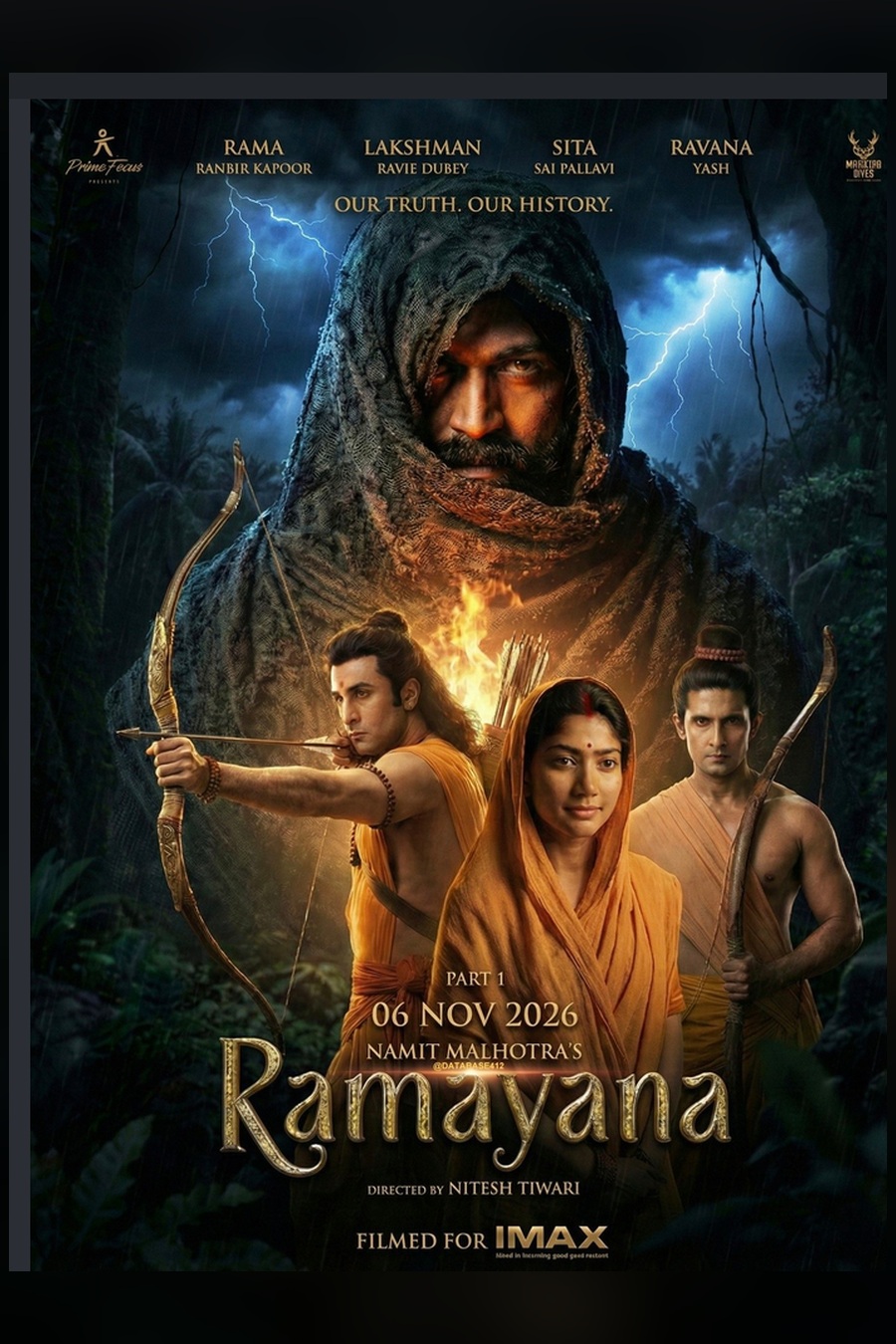
Ramayana
When divinity meets cinema, spectacle alone will never be enough. MovieHmm's grand pre-release analysis of the epic.
MOVIEHMM GRAND EDITORIAL | PRE-RELEASE SPECIAL | 82% ANTICIPATION. When divinity meets cinema, spectacle alone will never be enough. This is our detailed editorial prediction, not a review of the completed film.
1. THE BURDEN OF A STORY EVERYONE ALREADY KNOWS. Most filmmakers struggle to tell audiences what happens next. Ramayana faces a more difficult challenge: almost everyone already knows what happens next. We know about the exile, Sita's abduction, Hanuman's devotion, Ravana's pride and the confrontation between dharma and adharma. The suspense cannot come from artificial twists. It must come from making familiar decisions emotionally powerful. We know Rama accepts exile. The screenplay must make us feel what that acceptance costs him. MovieHmm Observation: The audience knows the destination. The screenplay must make the journey unforgettable.
2. RAMA — THE MOST DIFFICULT CHARACTER TO PORTRAY. Playing Rama is not simply about looking majestic, speaking gently or carrying a bow. His character balances personal emotion with public responsibility. He experiences loss, separation, uncertainty and conflict while remaining committed to principles that demand painful sacrifices. Ranbir Kapoor's greatest challenge will be communicating this emotional depth through restraint. Excessive solemnity could make the character distant. We should understand Rama's decisions rather than merely admire his image. Our expectation: quiet conviction instead of theatrical heroism.
3. SITA — THE EMOTIONAL CENTER, NOT A SUPPORTING CHARACTER. Sita's portrayal could determine whether Ramayana achieves genuine emotional resonance. Her story contains love, courage, dignity, resilience and extraordinary personal suffering. She cannot exist merely to motivate Rama's journey. Sai Pallavi brings expectations of emotional authenticity, and the screenplay must give Sita meaningful agency. The forest sequences, separation and her resistance during captivity should establish her perspective. A film that treats Sita only as a symbol will miss the complexity of her character. MovieHmm Observation: Sita must be experienced as a complete character, not simply revered from a distance.
4. RAVANA — THE ANTAGONIST MUST BE MORE THAN A MONSTER. Yash as Ravana is one of the adaptation's most intriguing possibilities. Ravana combines immense knowledge, power, ambition and devotion with arrogance and destructive choices. A compelling portrayal should preserve that complexity without excusing his actions. The most effective antagonist is not necessarily the loudest person in the room. If Ravana becomes a collection of roaring speeches and digitally enhanced expressions, his dramatic potential could disappear. Our expectation: an imposing antagonist whose pride is more frightening than his physical power.
5. HANUMAN — DEVOTION BEFORE SUPERHERO SPECTACLE. Hanuman offers extraordinary cinematic possibilities. His leap across the ocean, encounter with Sita and role in the battle could become unforgettable sequences. But those moments must be grounded in devotion. His greatness comes from the relationship between immense capability and complete dedication. The filmmakers must resist turning him into a conventional superhero. His strength matters because of the purpose behind it. MovieHmm Observation: Audiences should remember Hanuman's devotion long after the visual effects fade from memory.
6. LAKSHMANA — LOYALTY WITH A HUMAN COST. Lakshmana's commitment to Rama is celebrated, but its emotional cost deserves equal attention. His willingness to abandon comfort and accompany Rama into exile reflects extraordinary loyalty. Yet loyalty becomes dramatically meaningful when the screenplay acknowledges sacrifice. The relationship between the brothers should contain warmth, disagreement, concern and mutual understanding. Without these moments, even beautiful forest sequences may feel like illustrated mythology rather than lived experience.
7. NITESH TIWARI — THE DIRECTOR'S BIGGEST TEST. The director's responsibility extends far beyond staging epic battles. Ramayana must move naturally between intimate family drama, spiritual reflection, political conflict, separation, adventure and large-scale warfare. Each requires a different rhythm. Too much reverence could make the storytelling rigid. Too much modern action could undermine the material's emotional identity. The most difficult scenes may be the quietest ones. A farewell between family members must feel as significant as a battle involving thousands. MovieHmm Observation: Success will be measured by emotional continuity, not production magnitude.
8. SCREENPLAY — THE REAL MAKE-OR-BREAK FACTOR. Ramayana contains enough narrative material for an enormous cinematic universe. But more material does not automatically produce better cinema. Every sequence must have a dramatic purpose. Relationships must be established before separation, conflicts introduced before resolution and emotional consequences allowed to breathe. Different traditions contain different tellings of the epic, requiring careful adaptation choices. The greatest danger is replacing dramatic development with exposition. A character explaining dharma for five minutes may be less powerful than a character demonstrating it through one difficult decision. This is where MovieHmm remains most cautious.
9. VISUAL EFFECTS — GRANDEUR WITHOUT ARTIFICIALITY. Ayodhya, the forests, Lanka, celestial weapons, flying chariots and vast battlefields offer extraordinary world-building opportunities. But digital scale can become a weakness when every environment looks too perfect. Characters must feel physically present. Lighting, costumes, architecture, practical sets and visual effects should belong to one coherent world. The best visual effects will not announce themselves. They will make impossible environments emotionally believable. MovieHmm Observation: A convincing forest conversation may contribute more than an expensive but weightless battle sequence.
10. MUSIC — THE HEARTBEAT OF RAMAYANA. The musical expectations are immense. The score must carry devotion, longing, sacrifice, celebration, fear and triumph. A powerful soundtrack needs more than booming percussion and heroic chants. It needs memorable melodies. Rama and Sita's emotional identity, Hanuman's devotion and Ravana's menace should feel musically distinct. Silence will be equally important. Some moments become more powerful when music withdraws and actors carry the emotion. Our expectation: music that remains with audiences after the film ends.
11. CINEMATOGRAPHY — EVERY FRAME NEEDS A PURPOSE. A film of this scale can become a parade of beautiful images. But cinematography should communicate emotional states. Ayodhya can represent belonging and responsibility. The forest can communicate freedom and vulnerability. Lanka can embody power, temptation and isolation. The camera should move differently in intimate conversations and large-scale battles. If every scene is photographed as a grand spectacle, nothing will feel particularly grand. Visual contrast is essential.
12. THE EXPECTATIONS TRAP. Ramayana arrives with an unusually demanding audience. Some viewers will judge it against childhood memories. Others will compare earlier adaptations. Many approach it with deep religious and cultural attachment, while others evaluate it primarily as cinema. No adaptation can satisfy every interpretation. The filmmakers must remain faithful to the story's moral and emotional foundation while creating a coherent cinematic work. Trying to please everyone could produce a film afraid to make meaningful creative decisions. MovieHmm Observation: Respect for the source and confidence in storytelling must coexist.
13. WHAT COULD MAKE RAMAYANA EXTRAORDINARY? We want the exile to hurt. We want Sita's courage to inspire. We want Lakshmana's loyalty to feel personal. We want Hanuman's devotion to move us. And we want Ravana's downfall to feel like the inevitable consequence of his own choices. These achievements do not require the largest possible visual-effects budget. They require storytelling. If the film balances devotion and drama, it could deliver something genuinely memorable.
14. WHAT COULD GO WRONG? The greatest risk is mistaking scale for emotional impact. Excessive visual effects, ceremonial dialogue, rushed character development and an overextended screenplay could make the film impressive without making it affecting. A mythology adaptation can be technically spectacular and emotionally distant. That is the danger MovieHmm will watch most closely.
15. MOVIEHMM ANTICIPATION SCORECARD. Story and emotional foundation: 9.5/10. Casting and character potential: 8.5/10. Visual ambition and world-building: 9.0/10. Music and emotional atmosphere: 8.5/10. Direction and cinematic execution: 8.0/10. Screenplay and pacing confidence: 7.0/10. These are subjective pre-release expectations, not assessments of completed performances or technical work.
16. FINAL MOVIEHMM VERDICT — 82% HIGH ANTICIPATION. Ramayana has the foundation for an extraordinary cinematic achievement. Its story is timeless, its characters complex and its visual possibilities immense. But expectations are not evidence of execution. Our confidence rests on the source material and creative potential. Our caution rests on the difficulty of translating that potential into emotionally compelling cinema. THE MOVIEHMM LINE: A thousand spectacular frames cannot replace one moment that genuinely moves the heart. NO HYPE. NO HATE. JUST THE MOVIE. The final MovieHmm rating will be assigned only after viewing the completed film.
Timeless source material, powerful emotional foundation, Rama and Sita's journey, Hanuman's devotion, Ravana's complexity, casting potential, ambitious world-building and musical expectations.
Pre-release risks: excessive CGI, screenplay compression, uneven pacing, ceremonial dialogue, underdeveloped relationships and spectacle overwhelming emotion.
AI-generated review? Nope. I watch. I think. I judge. I rate. Technology just makes sure my English survives the journey from my head to your screen. The “hmm” is completely mine. 🤔
What did you think?
Your movie. Your reaction.