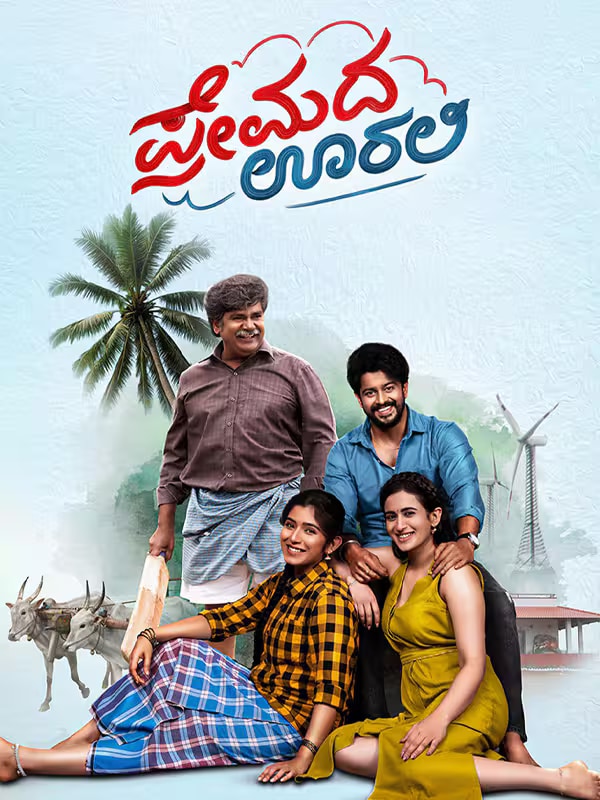
Premada Oorali
A warm father-son relationship, beautiful village atmosphere and soulful music. But does the film's idea of acceptance go far enough?
There is something refreshing about a Kannada film that doesn't depend on a superstar entrance, an enormous action sequence or a villain threatening the entire world. Premada Oorali places its faith in a father, his son, a village and the complications that arrive when love enters a family.
Director Manoj Kumar understands the appeal of ordinary lives. Naganna, played by Rangayana Raghu, has built his world around his son Santhu. Their relationship becomes the foundation for the film's disagreements, romance and emotional conflicts.
Rangayana Raghu is the strongest reason to take this story seriously. His character represents a generation that expresses affection through responsibility, expectations and sometimes interference.
What makes this relationship interesting is that love does not automatically mean understanding. A father may sacrifice everything for his son and still struggle to accept his decisions.
Shree Raam complements him with an understated presence. Santhu's pride in farming also gives the story a useful observation: why should a young man abandon the land he values merely to become an acceptable marriage prospect?
Rukmini's arrival changes the household. Through her, the film begins examining how society judges a woman's previous relationships. This is where the story has an opportunity to become more than a pleasant village romance.
But the treatment of acceptance deserves questioning. A woman's dignity should not depend on whether the men around her eventually decide to forgive or accommodate her past.
There is a difference between portraying a conservative society and allowing that society's assumptions to control the emotional argument. The film wants to celebrate acceptance, but its old-fashioned approach sometimes limits that message.
Thapaswini Poonaccha brings vulnerability to Rukmini, while Ramika Shivu's Vasantha introduces another emotional direction. Vasantha's feelings deserve attention because unreturned affection can matter as much as the relationship that succeeds.
The supporting characters contribute humour and village familiarity, although not every emotional thread receives enough development. Some relationships feel hurried towards resolution.
Sunaad Gowtham's music is an important strength. The songs contribute to the film's emotional identity rather than functioning merely as commercial interruptions.
Rajkanth SK's cinematography gives the village its own personality. The fields, homes and everyday surroundings provide visual warmth that expensive production design cannot automatically manufacture.
The early storytelling benefits from simple relationships and familiar humour. Later, the screenplay becomes increasingly dependent on emotional confrontations.
The problem is not melodrama itself. Family cinema can use heightened emotions effectively. The difficulty comes when a film explains feelings that its performers have already communicated.
At roughly two and a half hours, the film could have been tighter. Some conflicts deserve more development, while certain emotional scenes need less repetition.
Premada Oorali deserves appreciation for trusting a small, human story. Its father-son relationship, rural atmosphere, performances and music give it genuine appeal.
But warmth should not prevent criticism. The film occasionally mistakes familiar social thinking for emotional wisdom, and the later portions could have shown greater restraint.
A film does not become great simply because it makes us emotional. It becomes memorable when those emotions continue to make sense after we leave the theatre.
Rangayana Raghu, Shree Raam, rural atmosphere, Sunaad Gowtham's music, Rajkanth SK's cinematography and the father-son relationship.
Old-fashioned relationship attitudes, underdeveloped supporting emotions, slower portions and excessive melodrama.
AI-generated review? Nope. I watch. I think. I judge. I rate. Technology just makes sure my English survives the journey from my head to your screen. The “hmm” is completely mine. 🤔
What did you think?
Your movie. Your reaction.