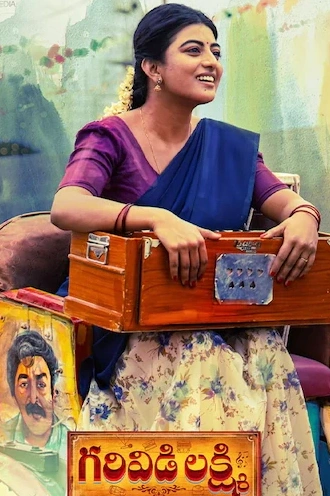
Garividi Lakshmi
A voice that once echoed across Uttarandhra finally gets its moment on the big screen. Anandhi gives the forgotten folk artist dignity and presence, but an uneven screenplay struggles to turn a remarkable life into equally remarkable cinema.
Some stories are worth telling because of the extraordinary lives behind them. Others deserve to be told because history has quietly pushed their subjects into obscurity. Garividi Lakshmi belongs to both categories. The film revisits the life of Reddy Vijaya Lakshmi, a folk performer whose voice travelled across Uttarandhra through live performances and audio cassettes. Her journey offers a powerful reminder that cultural recognition and personal security do not always arrive together.
Directed by Gowri Naidu Jammu, the film chooses an unconventional subject for mainstream Telugu cinema. There are no larger-than-life heroes, spectacular action sequences or familiar commercial formulas at its center. Instead, there is a woman whose identity is inseparable from Burra Katha, a traditional performance form combining storytelling, music and social commentary. That choice alone gives the film a distinctive cultural foundation.
The narrative introduces Lakshmi's difficult beginnings and follows her discovery of artistic purpose. Singing becomes more than an escape from personal hardship; it becomes a way to establish an identity in a world that offers her few opportunities. Her association with Satthibabu and Rambabu introduces new possibilities, but recognition also brings complicated relationships, competing interests and painful consequences. The central dramatic question is compelling: how does someone whose voice reaches so many people eventually find herself struggling for recognition?
Anandhi is the strongest reason to remain invested. Rather than approaching Lakshmi as a conventional biographical heroine, she gives the character a grounded presence. Her expressions, body language and stage performances communicate both the confidence of an entertainer and the vulnerability of a woman navigating difficult circumstances. She appears especially comfortable in the musical sequences, where the character's relationship with her art becomes immediately believable.
The supporting cast contributes useful texture. Rag Mayur's Satthibabu is important to the changing personal and professional dynamics surrounding Lakshmi. V.K. Naresh brings experience and weight to Rambabu. Their performances help establish the world around the protagonist, although the writing does not always explore the complexity of these relationships as deeply as it could. A compelling biopic needs supporting characters who feel like fully developed people rather than figures appearing at important moments in the subject's life.
Charan Arjun's music is central to the film's identity. The folk compositions and traditional performance style carry a sense of place that a conventional commercial soundtrack could not provide. These passages remind us that Lakshmi's importance extends beyond her individual biography. She represents a performance tradition sustained by regional audiences, travelling artists and communities whose cultural contributions rarely receive the attention reserved for mainstream celebrities.
There is an interesting tension between the film's musical strength and its dramatic weakness. The songs establish authenticity and atmosphere, but musical authenticity alone cannot maintain narrative momentum. A performance can be culturally valuable without necessarily advancing the story. At several points, the screenplay appears more concerned with presenting the next event in Lakshmi's life than exploring the emotional consequences of the previous one.
The film's central limitation is therefore not its subject but its construction. Lakshmi's rise, changing relationships and eventual difficulties contain the ingredients of a gripping drama. Yet the narration often feels chronological rather than dramatically shaped. Events occur, circumstances change and the story moves forward, but the transitions do not consistently produce the emotional escalation expected from a strong biographical film.
The framing device, in which filmmakers attempt to discover Lakshmi's story, inevitably invites comparison with other Telugu biopics, particularly Mahanati. The comparison is less about subject matter than narrative technique. A retrospective structure can create mystery, anticipation and emotional revelation. Here, however, the framing does not consistently transform the audience's understanding of the central character. The film has important information to communicate, but information and dramatic engagement are not the same thing.
Pacing compounds the problem. The early sections take considerable time establishing circumstances, while some later developments repeat emotional ideas without deepening them. A tighter edit and more carefully structured confrontations could have given the narrative greater urgency. The material does not need artificial commercial twists, but it does need stronger dramatic progression. Authenticity should make the story more immediate, not excuse an absence of momentum.
The later passages are more affecting because the consequences of Lakshmi's journey become clearer. Recognition, dependency, exploitation and disappointment begin to intersect in ways that reveal the human cost behind the public performer. These moments suggest the more powerful film that might have emerged had the screenplay developed its emotional conflicts earlier and more consistently.
The production's attention to regional atmosphere deserves acknowledgment. The rural setting, stage environments, costumes and Uttarandhra dialect help distinguish Lakshmi's world from the generic backgrounds of many commercial dramas. Cinematography by Aditya Javvadi supports this rooted quality. However, Ravi Teja Girijala's editing cannot completely overcome the screenplay's repetitive stretches. Visual credibility and cultural detail enrich the experience, but they cannot independently create narrative tension.
Beyond its filmmaking strengths and weaknesses, Garividi Lakshmi raises an important question about how society values its artists. Popularity can be temporary, financial security uncertain and public memory surprisingly selective. A performer may become part of a region's cultural identity without receiving the institutional recognition or long-term support that such a contribution deserves. This is the film's most meaningful underlying idea.
There is also something admirable about a production choosing to preserve the story of a regional folk artist at a time when mainstream cinema increasingly depends on scale, spectacle and recognizable intellectual property. That ambition deserves credit. But respecting the subject does not require overlooking the film's weaknesses. In fact, a remarkable real-life figure deserves especially disciplined storytelling.
Garividi Lakshmi ultimately works better as a tribute than as a consistently absorbing cinematic experience. Anandhi gives the film its emotional center, and Charan Arjun's music preserves the spirit of its subject. The screenplay, however, struggles to convert that sincerity into sustained dramatic impact. The result is a culturally meaningful biopic with worthwhile performances and a story that deserved sharper treatment.
Anandhi's grounded and expressive portrayal anchors the film. Charan Arjun's folk music gives the story authenticity and regional character. The Uttarandhra setting, dialect and traditional stage performances preserve a distinctive cultural identity. The decision to spotlight an overlooked female folk artist gives the film genuine significance. The later emotional passages offer glimpses of the drama's unrealized potential.
The screenplay is too chronological and insufficiently dramatic. Slow pacing and repetitive passages weaken audience engagement. Important personal relationships lack the depth needed to make every turning point resonate. Several musical sequences interrupt rather than advance the narrative. The retrospective biopic structure invites comparisons the film cannot consistently sustain. The emotional consequences of Lakshmi's rise and decline deserved stronger development.
AI-generated review? Nope. I watch. I think. I judge. I rate. Technology just makes sure my English survives the journey from my head to your screen. The “hmm” is completely mine. 🤔
What did you think?
Your movie. Your reaction.