The film establishes its youthful world sincerely, but the behaviour sometimes feels designed to preserve an older cinematic innocence rather than observe current teenagers.
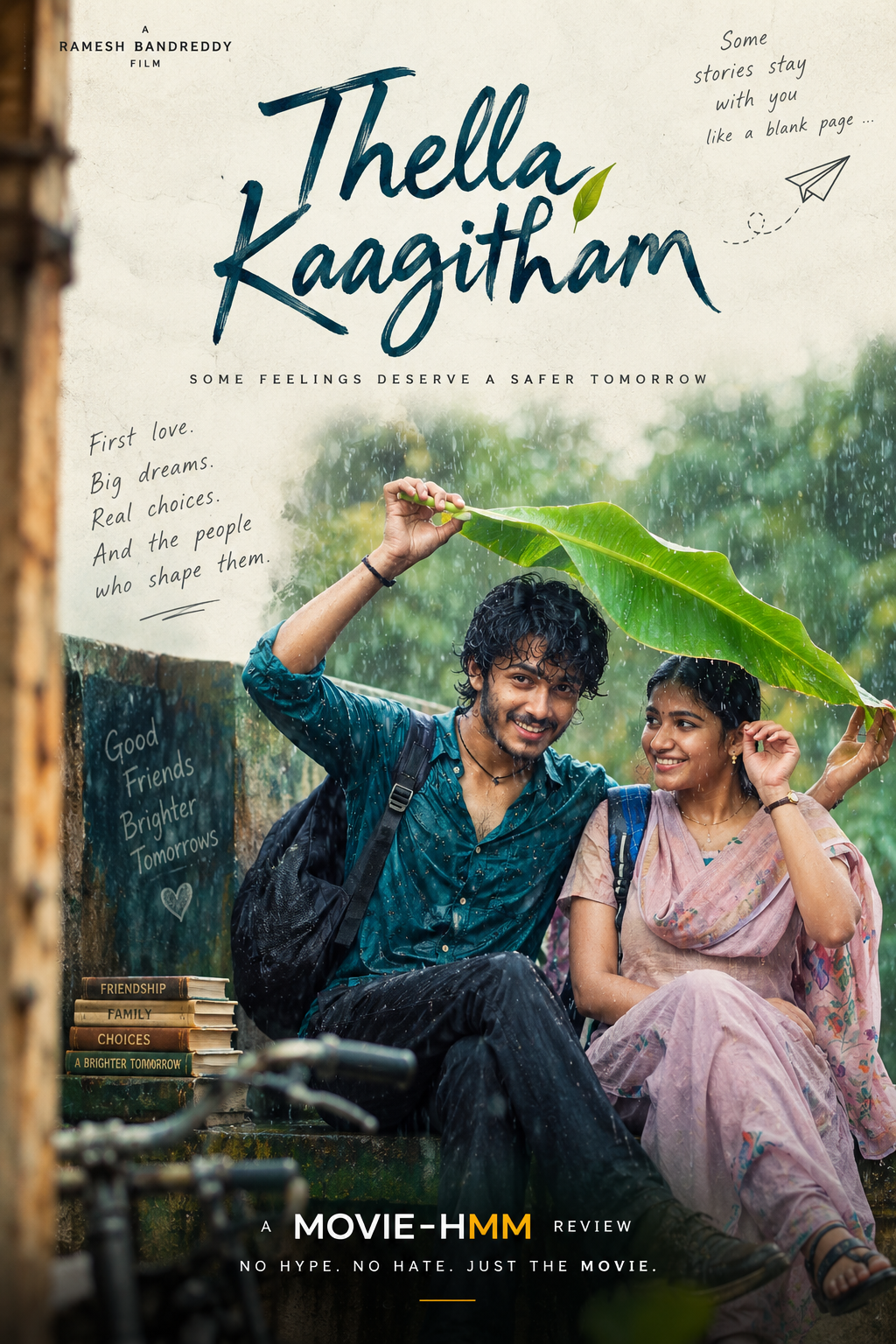
🎬 THE Movie....🤔hmm POSTMORTEMTelugu · AFTER RELEASE
Thella Kaagitham
🟠
FINAL DIAGNOSISGOOD INTENTION, OLD GENERATION LENS
The message wants to understand teenagers. The screenplay sometimes remembers teenagers instead.
Who connected. Who didn't. Why.
Viewers who connected with the film responded to its sincerity, parental communication and friendship message. The resistance comes from its dated understanding of how contemporary teenagers think, communicate and encounter relationships.
Where did the pulse change?
The conflict becomes clearer, but the film has already revealed much of what it wants to say.
The message begins repeating itself. Ideas that were meaningful the first time lose force because the screenplay keeps explaining rather than discovering.
Sincerity, parent-child communication, responsible friendship, Nakshatra and the film's refusal to treat vulnerable teenage emotion merely as shock material.
A dated view of teenagers, repetitive second-half messaging, uneven pacing and insufficiently contemporary behavioural detail.
Nobody escapes the table.
Harsh Roshan is sincere, but the role needed greater ease and emotional variation.
Nakshatra brings confidence and helps prevent the young characters from feeling entirely schematic.
The film does not need a conventional villain. Manipulation, immaturity and poor communication are the real opposing forces, but they needed more contemporary observation.
Ramesh Bandreddy's sincerity is visible. His next youth film should begin with observation of present-day behaviour rather than inherited ideas about adolescence.
The film's message is useful: parents should listen, children should trust and friends should sometimes challenge rather than blindly support. The weakness is repeatedly stating those ideas instead of embedding them naturally in contemporary behaviour.
The music supports the film but does not create the distinctive youthful identity the material could have used.
Songs fit the emotional space but could have been used to reveal character rather than mainly maintain mood.
The second half needed compression. Once the audience understands the message, repetition reduces rather than increases its power.
The visual approach supports the youthful and nostalgic tone but sometimes reinforces the feeling that the film is looking backward.
Youth films need cultural research as much as casting. Authentic contemporary behaviour is production value.
What should they learn?
Natural ease matters more than visible effort in a youth drama.
Do not make the teenagers you remember. Observe the teenagers who exist now.
A message becomes stronger when characters discover it instead of delivering it.
Youth music should reveal generational identity, not simply accompany romance.
Once the point lands, move forward.
Invest in research and authentic voices before trying to manufacture youth appeal.
Rewriting the same core story around genuinely contemporary teenage behaviour would have made the film's message substantially more powerful.
THE FINAL POSTMORTEM
Thella Kaagitham has worthwhile things to say about young people. Its biggest problem is that it sometimes speaks about today's generation using yesterday's vocabulary.